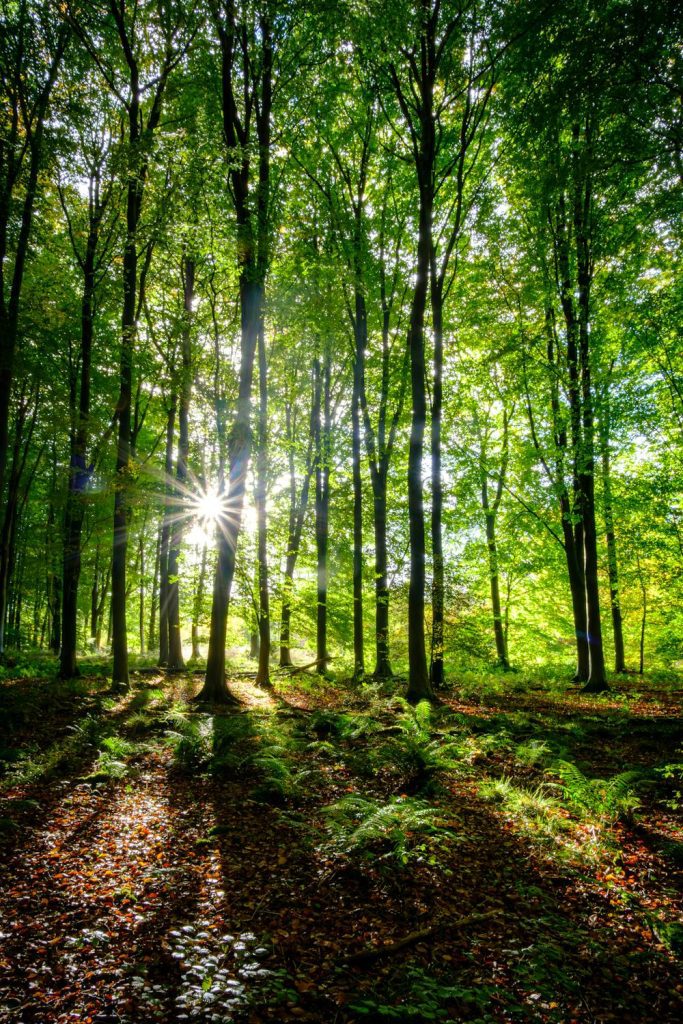
I have only called Brockenhurst home for the last couple of years, which means the New Forest is an endless source of wonder. Walking these ancient woodlands, sprawling heaths, and mysterious bogs with my husband and our dog has given me an intimate connection with it. In this guide, I’ll show you some of the unique plants and wildflowers that make the New Forest a botanical treasure trove unlike anywhere else in Britain.
The New Forest’s exceptional plant diversity stems from its unusual mix of habitats—ancient woodland dating back centuries, open heathland, acid bogs, and river valleys—all existing in a delicate balance maintained by traditional commoning practices. With over 700 wildflower species recorded across the Forest, this rich tapestry of plant life deserves not just our admiration but our protection too.
Ancient Woodland Flora
Bluebell Carpets
Nothing quite captures the magic of the New Forest in spring like the swathes of bluebells that transform the woodland floor into a sea of violet-blue. As April arrives, a walk in Roydon Woods near my home in Brockenhurst, is fast becoming a tradition, where the bluebells create what feels like an enchanted realm beneath the ancient oak canopy.
These native bluebells (Hyacinthoides non-scripta) are indicators of ancient woodland—land that has been continuously wooded since at least 1600. Their sweet scent fills the air, and I’ve found that early morning visits, when dew still clings to the nodding flower heads, offer the most breathtaking views. The New Forest bluebells reach their peak around late April to early May, and walking amongst them connects you to a landscape that has remained essentially unchanged for centuries.

Wild Daffodils
While garden daffodils are commonplace, the wild daffodil (Narcissus pseudonarcissus) is a much rarer sight. Smaller and more delicate than their cultivated cousins, these native daffodils have pale yellow petals surrounding a deeper yellow trumpet. There’s something profoundly special about spotting these untamed blooms, knowing they haven’t been planted by human hands.
Over near Minstead and in parts of Denny Wood, these golden flowers emerge as early as February in mild years. Their numbers have fluctuated over time, with recent conservation efforts helping to secure their future in the Forest. Their presence tells a story of continuity in a landscape where few things have changed over centuries.

Wood Anemones
One of my earliest spring memories is coming to the New Forest as a child, and lying on my stomach in Frame Wood, watching wood anemones (Anemone nemorosa) slowly opening their star-like white flowers to face the strengthening spring sunshine. These delicate flowers, sometimes tinged with pink, are among the most reliable indicators of ancient woodland.
Wood anemones spread extremely slowly—about six feet per century—meaning large colonies like those found in the New Forest have likely been established for hundreds of years. They bloom before the tree canopy fully leafs out, taking advantage of the spring sunshine reaching the forest floor. By late May, they’ve completed their lifecycle and vanish back underground until the following spring.

The Fungal Kingdom
While not strictly wildflowers, I can’t talk about the New Forest’s plant life without mentioning its extraordinary fungi. With over 2,700 recorded species, the Forest ranks among Britain’s most important fungal habitats.
Autumn transforms the woodland floor into a mycologist’s paradise. From the iconic fly agaric’s red and white spotted caps to the bizarrely shaped coral fungi, these remarkable organisms play crucial roles in maintaining forest health.
Heath and Moorland Specialties
The Heathers
The open heathlands of the New Forest provide some of its most iconic views, especially in late summer when the heathers bloom. Bell heather (Erica cinerea) produces deep purple flowers from June, while cross-leaved heath (Erica tetralix) adds a paler pink to the palette. Common heather or ling (Calluna vulgaris) follows, turning the landscape into a purple haze through August and September.
My favorite spot to experience this spectacular display is the high heathland around Ocknell Plain. Standing there as the setting sun bathes the flowering heather in golden light remains one of my most treasured New Forest experiences, no matter how many times I witness it.

Gorse
There’s an old country saying: “When gorse is out of bloom, kissing is out of fashion.” Given that gorse blooms somewhere in the Forest throughout the year, this is good news for romantics! The coconut-scented yellow flowers of common gorse (Ulex europaeus) are at their most prolific in spring, but you’ll find some flowers even on the coldest winter days.
Gorse creates crucial shelter for many of the Forest’s birds and invertebrates. The dense, spiny bushes that sometimes seem to grab at your clothing when passing actually serve as natural nurseries for the wider ecosystem. The best examples grow along the forest edges where woodland meets heath, creating important transitional habitats.

Bog Asphodel
The New Forest’s wet mires host some of its most specialized plants, adapted to the waterlogged, nutrient-poor conditions. Among the most striking is bog asphodel (Narthecium ossifragum), whose tall spikes of star-shaped yellow flowers light up the bogs from June to August.
Walking the boardwalk at Fletchers Water near Brockenhurst offers safe access to view these fascinating plants without damaging the fragile bog ecosystem. The name “ossifragum” means “bone-breaker,” as it was once believed to cause brittle bones in cattle (though this was actually due to the poor nutrition provided by the boggy pastures where it grows).
Carnivorous Plants
The poor nutrient content of New Forest bogs has driven some plants to evolve extraordinary adaptations—including carnivory. Round-leaved sundews (Drosera rotundifolia) are among my favorite Forest plants, with their tiny red leaves covered in glistening droplets that both attract and trap insects.
I still remember my childhood fascination upon discovering these plants actually “eat” insects. The sticky droplets on their leaves contain digestive enzymes that break down trapped prey, allowing the plant to absorb nutrients otherwise unavailable in the acidic bog environment. Look for them in the wetter parts of Hincheslea Bog or along the edges of Cranes Moor—but please stick to paths to protect these sensitive habitats.
Rare and Protected Species
Wild Gladiolus
Perhaps the most special plant in the entire New Forest is the wild gladiolus (Gladiolus illyricus). With fewer than 30 known sites in the UK, almost all in the New Forest, this tall plant with striking pink-purple flowers represents one of Britain’s rarest wildflowers.
I’ll never forget my grandfather showing me my first wild gladiolus blooming in a secret location near Roydon Woods. Their flowering period is brief—just a few weeks in June and July—and finding them requires both knowledge and patience. Their location is carefully guarded by conservationists, and I follow that tradition by never revealing specific sites online.
Coral Necklace
With its unusual string of tiny pink flowers resembling a necklace, coral necklace (Illecebrum verticillatum) is a nationally rare plant that finds sanctuary in the New Forest. It grows in damp, gravelly areas where seasonal pools form in winter but dry out in summer.
The traditional practice of allowing ponies and cattle to create hoof prints and disturb the ground actually helps this diminutive plant by creating the small depressions it needs to thrive. Conservation work focusing on maintaining these traditional grazing patterns has been crucial to its survival.
Wild Chamomile
The sweet-scented wild chamomile (Chamaemelum nobile) creates carpets of daisy-like flowers across certain New Forest lawns in summer. Also known as lawn chamomile, it thrives in areas grazed by the Forest’s famous ponies and cattle.
As a child, I remember my grandmother collecting these flowers to make tea, continuing a tradition of herbal medicine that stretches back centuries in the Forest. The ‘lawns’ where chamomile grows have often been maintained by grazing animals for hundreds of years, creating a living link to the Forest’s past.
Marsh Gentian and the Marsh Fritillary Connection
The deep blue trumpets of marsh gentian (Gentiana pneumonanthe) are not just beautiful—they’re essential for the survival of the rare marsh fritillary butterfly. The butterfly’s caterpillars feed exclusively on devil’s-bit scabious, but the adult butterflies favor the nectar of marsh gentians.
This delicate relationship illustrates how the Forest’s plant and animal communities have evolved together over millennia. Spotting marsh gentians in bloom around Cranes Moor in late summer always feels like a special privilege, knowing how many creatures depend on their continued presence.
See More: Best Flowers for Bees: A Beekeeper’s Guide for a Bee-Friendly Garden
Best Viewing Locations: My Personal Favorites
Roydon Woods
This Hampshire Wildlife Trust reserve near Brockenburst offers some of the best bluebell displays in the Forest, along with exceptional wood anemone colonies. The mix of ancient woodland, meadows, and streams creates diverse habitats supporting a wide range of plant species.
The carefully maintained paths allow access without damaging sensitive areas. Spring is the prime season here, but the variety of habitats means there’s botanical interest year-round.
Ober Water Walk
Starting from the heart of Brockenburst, this gentle walk follows the crystal-clear Ober Water through a changing landscape of woodland and heath. The damp areas along the stream host specialties like bog pimpernel and marsh St. John’s wort, while drier sections feature heathers and gorse.
In spring, look for the delicate pale pink flowers of cuckooflower along the water’s edge. By summer, the open sections burst with heather and the strange insectivorous sundews appear in boggy patches. This accessible route offers year-round interest and is a go-to place for introducing visitors to the Forest’s plant diversity.
Whitley Wood
This magnificent ancient woodland northwest of Brockenburst exemplifies the Forest’s traditional “pasture woodland”—ancient trees with open areas maintained by grazing animals. The resulting dappled light creates perfect conditions for woodland flowers like wood sorrel, with its delicate white blooms and clover-like leaves.
Autumn brings an extraordinary display of fungi here, with everything from tiny bonnet mushrooms to massive bracket fungi on fallen trees. The mix of oak and beech creates varying light conditions that support different plant communities within a relatively small area.
Balmer Lawn
Unlike much of the Forest, the grasslands around Balmer Lawn offer a glimpse of traditional meadow species. In summer, the area comes alive with yellow rattle, eyebright, and occasional orchids.
The lawn has been maintained by grazing and occasional cutting for centuries, creating conditions where these specialized plants can thrive. Standing here on a summer evening, watching the Forest ponies grazing among wildflowers with the ancient trees as backdrop, feels like stepping back into an earlier England.
Photography Tips: How to Capture the Forest’s Flora
The Golden Hours
Early morning and late afternoon provide the most magical light. Morning dew adds sparkle to delicate structures like sundew leaves, while evening light bathes the purple heather in golden tones.
For woodland flowers like bluebells, slightly overcast days often work best, reducing harsh contrast and allowing the true colors to shine. I’ve found that getting low—sometimes lying flat on the ground—offers the most compelling perspective for many of the Forest’s smaller plants.
Seasonal Favorites
Each season offers different photographic opportunities. Spring brings the challenge of capturing the vast bluebell carpets in a way that conveys their true impact—try using a wide-angle lens while including some taller trees for scale. Summer heathland flowers often benefit from a macro lens to reveal their intricate structures.
Autumn fungi photography requires patience and careful attention to light. Serious photographers use a small reflector to gently illuminate fungi growing in dark woodland corners. Winter offers opportunities to capture the architectural forms of seedheads and dried stems, especially when rimmed with frost or morning dew.
Some of my favorite locations for plant photography include the dappled light of Roydon Woods for spring flowers, the open vistas of Ocknell Plain for summer heather, and the sheltered glades of Mark Ash Wood for autumn fungi.
Ethical Photography Practices
Photograph and treat the Forest with care and respect. Using a telephoto lens for close-ups rather than trampling vegetation to get closer, staying on established paths in sensitive areas, and never picking or moving plants are essential practices.
For rare species like wild gladiolus, avoid sharing precise locations online, instead focusing on capturing the plant’s beauty without revealing identifying background features. This approach helps protect vulnerable populations from potential disturbance.
Conclusion: Unique Plants and Wildflowers of the New Forest
Walking and exploring the New Forest’s woods, heaths, and bogs, I’ve developed a deep appreciation for its extraordinary plant life. From the spring explosion of bluebells to the summer purple of heather, from rare orchids to abundant fungi, these plants mark the passing seasons and years for all of us that see them now and hopefully for future generations.
I invite you to explore the New Forest’s plant life for yourself—respectfully, mindfully, and with a sense of wonder. Look closely at the small things, learn to recognize the changing seasons through the plants that mark them, and consider how you might contribute to protecting this precious living tapestry.
After all, the story of the New Forest’s plants is our story too—one of adaptation, resilience, and the enduring connections between people and place.


Leave a Reply