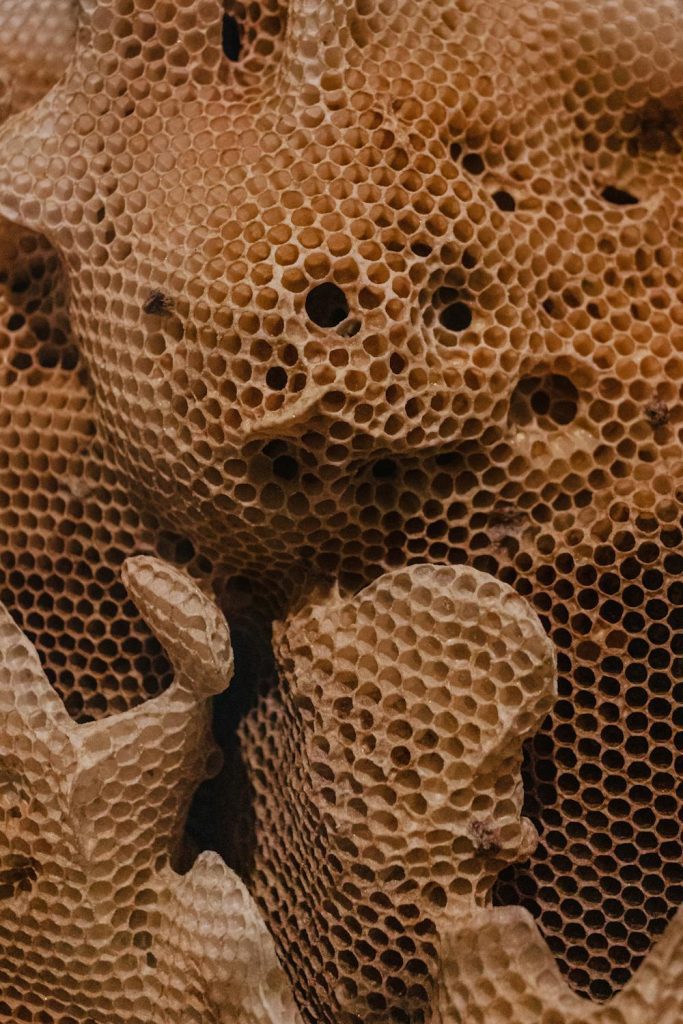
As I stood in my apiary one warm spring morning, watching my bees through the observation window of a Langstroth hive, I was once again struck by the perfect symmetry of their honeycomb. This architectural wonder fascinates me. How do these small insects, with brains smaller than a pinhead, create structures that have puzzled mathematicians and engineers for centuries?
The honeycomb stands as one of nature’s most efficient designs—a perfect arrangement of hexagonal cells that serves as both nursery and pantry for the colony. In this article, I’ll share the remarkable process of how honeybees construct their iconic honeycomb with such precision and mathematical accuracy, drawing from both scientific research and my years of firsthand observation.
The Geometric Perfection of Honeycomb
The first thing that strikes anyone observing a honeycomb is its perfect hexagonal pattern. This isn’t random—it’s the result of millions of years of evolutionary refinement.
Honeybees build their combs with hexagonal cells for a compelling reason: efficiency. Among all possible shapes that could tessellate (fit together without gaps), hexagons require the least amount of wax to create cells of a given volume. This was proven mathematically in what’s known as the “honeycomb conjecture,” formally demonstrated by mathematician Thomas Hales in 1999, though bees solved this problem millions of years ago.
I’ve measured hundreds of cells across different hives in my apiary, and the consistency is remarkable—cell diameters typically measure about 5.2 to 5.4 millimeters for worker cells, with walls approximately 0.073 millimeters thick. This precision isn’t just impressive; it’s critical for the colony’s survival.
The hexagonal design provides maximum strength with minimum material. When I harvest honeycomb and handle it, I’m always struck by how the structure can support thirty times its own weight, despite walls thinner than paper. This strength comes from how the cells connect, creating mutual support throughout the structure.
But there’s more to the hexagon’s advantage. A round shape would theoretically use even less wax per cell, but round cells would leave wasted spaces between them. Triangular or square cells would fit together without gaps, but would require more wax to build. Nature has selected for efficiency, and hexagons provide the perfect balance of space efficiency, structural strength, and material conservation.
Materials for Construction
Before understanding how bees build comb, we need to appreciate the remarkable material they use: beeswax.
Young worker bees, typically between 12-20 days old, produce wax through special glands on their abdomen. I’ve often observed these workers hanging motionless in chains, a behavior called “festooning,” while their wax glands are active. They consume large quantities of honey—about eight pounds of honey to produce one pound of wax—converting this energy-rich food into tiny wax flakes that appear on their underside.
The process is energy-intensive and temperature-dependent. The colony must maintain a temperature of about 95°F (35°C) for optimal wax production. I’ve noticed that comb building slows dramatically during cool weather, even when nectar is abundant, as the bees struggle to maintain this ideal temperature.
Once secreted, the wax appears as small, transparent scales about 3mm long. Worker bees collect these flakes using their legs, pass them to their mouths, and then chew them, mixing in saliva containing special enzymes. This process makes the wax pliable—transforming it from brittle flakes to a workable construction material.
The wax at this stage has a creamy white color. It only develops the yellow, amber, or brown tones we associate with older honeycomb after being in contact with honey, propolis, and through the traffic of thousands of bee feet walking across its surface.
The Construction Process: Step by Step
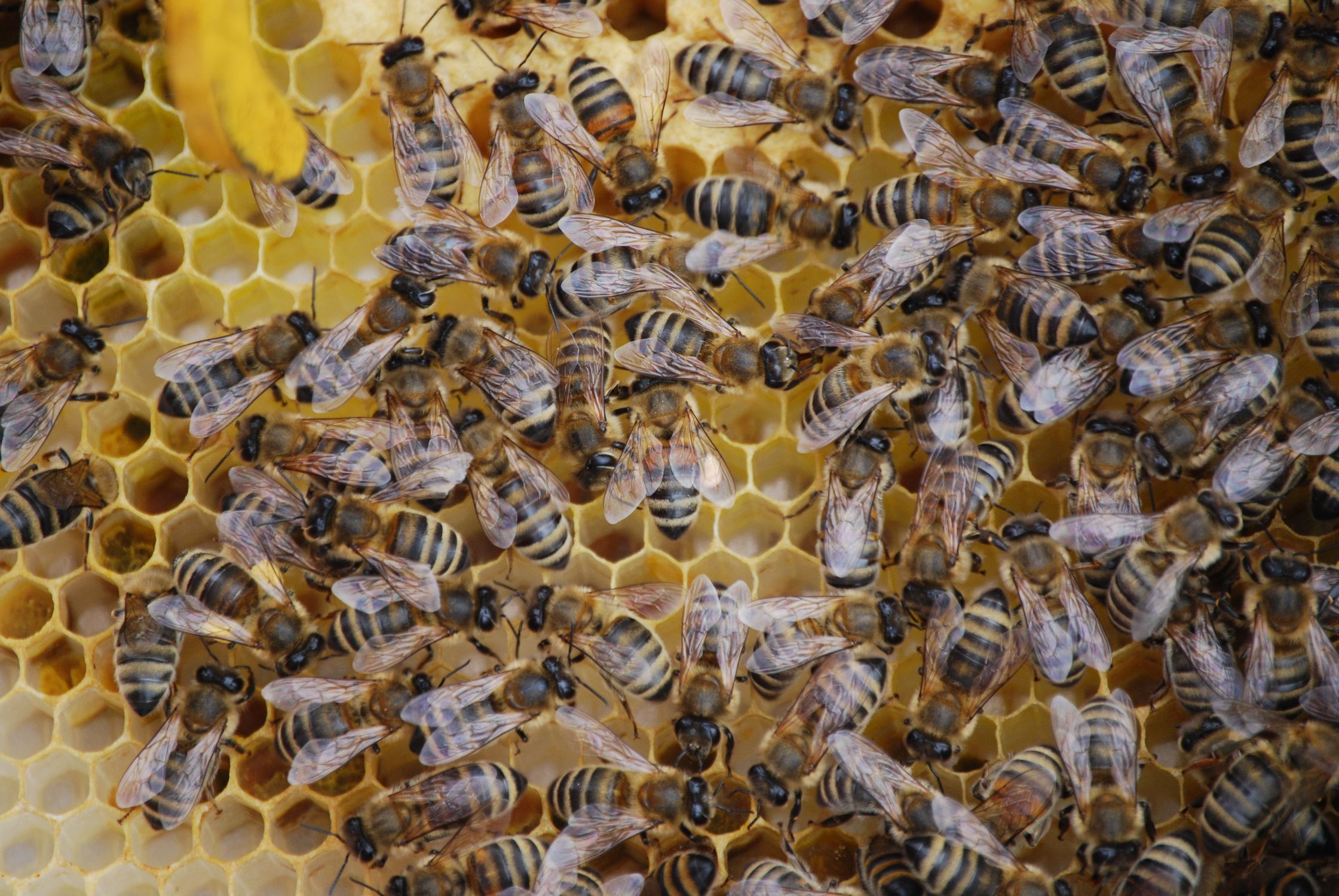
The sequence of comb building follows a remarkably organized progression. Having observed this process through observation hives countless times, I can break it down into distinct phases:
First comes the site selection. In natural settings, scout bees would identify suitable locations for the colony. In a managed hive, we provide the space, but bees still make decisions about where within that space to begin construction. They typically start building from the top and work downward, using gravity as a natural plumb line.
Once the site is selected, workers form “festoons” or chains, hanging from the attachment point. These living chains serve multiple purposes: they help maintain the crucial construction temperature, they establish the vertical plane for the comb, and they allow efficient passing of wax from producers to builders.
The master builders begin by creating a thin ridge of wax along the attachment surface—what I call the “foundation ridge.” From this, they draw out the first shallow cells. What’s fascinating is that they don’t complete one cell at a time. Instead, they work on multiple cells simultaneously, gradually extending the walls outward.
The initial cells often appear somewhat irregular, but as construction continues, the pattern becomes increasingly precise. The bees work from both sides of the comb simultaneously, with the cell bases slightly offset so that each cell base on one side consists of portions of three cells from the opposite side. This interlocking arrangement adds tremendous strength to the structure.
The timing of construction varies with conditions. In optimal conditions—warm weather with abundant nectar flow—I’ve seen colonies draw out a full deep frame of foundation in just 1-2 days. During moderate conditions, the same progress might take a week. If nectar is scarce or temperatures are cool, comb building might halt entirely as the colony conserves resources.
The Division of Labor During Construction
The comb-building process reveals the sophisticated division of labor within the colony. This isn’t random but follows a precisely organized system based primarily on worker age:
Young workers (approximately 12-18 days old) serve as the primary wax producers. Their wax glands are fully developed at this stage of their lives. I’ve watched these bees hang quietly in chains, their bodies converting honey into wax scales.
Slightly older workers often function as wax handlers—collecting scales from producers, masticating the wax, and passing it to the builders. This middle step ensures a constant supply of workable material.
Master builders (typically experienced workers) place the wax and form the precise hexagonal cells. Their movements appear deliberate and measured, using their bodies as living measuring tools.
Quality control workers travel across the developing comb, making adjustments and repairs as needed. I’ve observed these bees spending time inspecting completed sections, sometimes removing and reworking areas that don’t meet the colony’s standards.
Beyond these specialized roles, other workers maintain the critical microclimate, bringing water to evaporate and cool the area if it gets too hot, or clustering more densely to generate heat if temperatures fall. The entire operation functions like a coordinated construction crew, but without a foreman giving orders.
Instead, this complex coordination happens through what scientists call “stigmergy”—a mechanism of indirect coordination where the trace left in the environment by one action stimulates the next action. In simpler terms, each bee responds to the current state of the construction rather than following explicit instructions. It’s a system that produces remarkable results without centralized control.
See More: Inside the Hive: What Do Worker Bees Actually Do?
The Science Behind Temperature and Consistency
Temperature plays a crucial role in comb construction, affecting both wax production and workability. This is something I’ve observed directly in my own hives across different seasons.
Bees maintain the brood nest and construction areas at a remarkably precise 93-95°F (34-35°C). Below this temperature, the wax becomes brittle and difficult to work. Above about 100°F (38°C), it becomes too soft to maintain structural integrity.
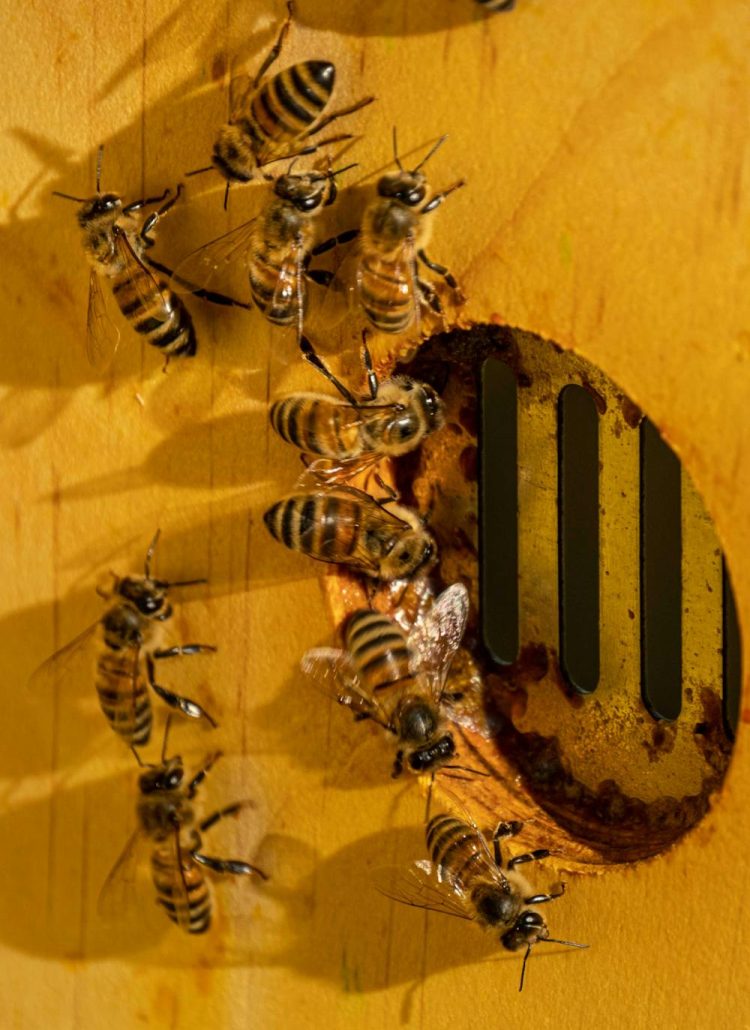
During hot weather, worker bees serve as living climate controllers. They collect water and distribute it throughout the hive, fanning vigorously with their wings to create evaporative cooling. On particularly hot days, I often see lines of bees stationed at the entrance, fanning in coordinated waves to ventilate the entire structure.
In cooler conditions, bees cluster more densely in the construction area, using their bodies to generate heat through muscle contractions. This thermoregulation requires significant energy—another reason why comb building is primarily a warm-weather activity when nectar is abundant.
The consistency of the wax itself changes throughout the construction process. Freshly secreted wax is relatively brittle. After being chewed and mixed with saliva, it becomes more pliable. As the comb ages and is polished by countless bee footsteps, it develops a harder, more durable surface.
Research has shown that bees also adjust the composition of their wax depending on environmental conditions. In warmer climates, they produce wax with slightly higher melting points by adjusting the proportion of different esters and acids in the wax.
Environmental Factors Affecting Comb Building
The availability of nectar dramatically influences comb construction. During strong nectar flows, when bees are bringing in more honey than they have space to store, comb building accelerates dramatically. I’ve seen colonies draw out entire supers of foundation within days during strong flows.
Conversely, during dearth periods, comb building typically halts entirely. The bees simply can’t afford the energy expenditure when resources are scarce. This is why experienced beekeepers time the addition of foundation to coincide with nectar flows.
Seasonal variations also impact construction patterns. Spring comb tends to feature more worker-sized cells, supporting the colony’s need to build its workforce. Late summer comb often includes more drone cells, particularly along the periphery of frames.
Space constraints influence building patterns as well. When bees encounter obstacles or irregular spaces, they modify their construction accordingly. This adaptability allows them to maximize available space, though sometimes in ways that make beekeepers cringe—like when they build “bridge comb” between frames or attach comb to hive walls.
I’ve noticed that colonies with young, prolific queens tend to build comb more readily than those with older queens. This makes evolutionary sense—a colony with a young queen has a longer future ahead and greater need for expanded nest space.
Natural Comb vs. Foundation: Differences in Building
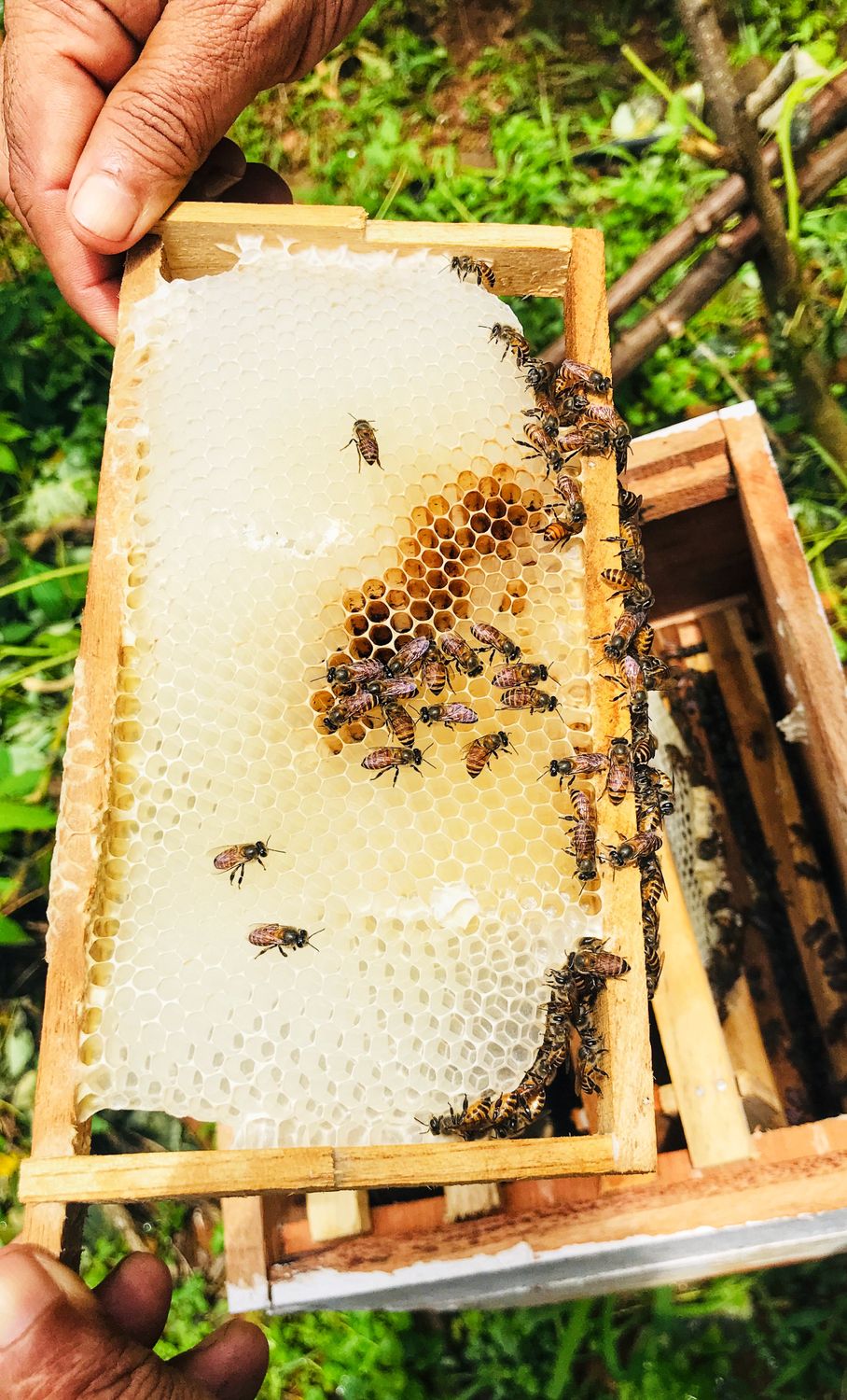
Modern beekeeping typically employs foundation—thin sheets of embossed wax or plastic with hexagonal patterns—to guide the bees’ construction. But there are significant differences between how bees build on foundation versus how they build naturally.
In natural construction (what we call “foundationless” beekeeping), bees determine their own cell sizes and arrangements. What I’ve observed in my foundationless frames is that bees typically build a range of cell sizes: smaller cells for workers in the central brood area (about 4.9mm diameter), larger cells for drones (about 6.2mm) usually toward the periphery, and occasionally transition zones with intermediate-sized cells.
When building on standard foundation, bees are constrained to the cell size embossed on the foundation—typically about 5.4mm for conventional foundation. This uniformity makes frames more interchangeable but eliminates the natural variation in cell sizes.
Natural comb also tends to include more drone cells—typically 10-20% of cells in a natural nest, compared to the 5% or less on standard worker foundation. This difference has implications for Varroa mite management, as the mites preferentially reproduce in drone cells.
I’ve found that bees draw out natural comb with remarkable speed when given the opportunity. Without foundation, they aren’t constrained to building on both sides simultaneously, and can progress more quickly on one side initially. However, they’re also more likely to build in unexpected directions without the guidance foundation provides.
The debate between natural and foundation-guided building continues in beekeeping circles. I’ve experimented with both approaches and found merits to each. Foundation provides predictability and ease of management, while natural building allows the colony to express its own building preferences and potentially supports more natural behaviors.
Common Problems and Solutions in Comb Construction
Cross-combing—where bees build comb perpendicular to the intended direction—is perhaps the most frustrating. This typically happens when bees don’t have proper guides or when frames aren’t properly spaced. I prevent this by ensuring frames have clear starter strips or foundation, keeping frames properly spaced, and making sure the hive is level from side to side.
Wavy or uneven combs often result from frames being too far apart or from the colony having too much space to fill at once. I’ve learned to add only as many frames as the colony can work on at a time, and to keep existing frames tightly together.
Burr comb—extra comb built between frames or in spaces where we don’t want it—occurs when bees encounter spaces larger than 3/8 inch (what we call “bee space”). They instinctively fill these gaps. Maintaining proper bee space throughout the hive is the best prevention.
When bees build comb in unwanted places, like between the inner cover and top bars, it usually indicates they need more space or that the frames aren’t properly positioned to guide their building instincts. Adding supers before the existing ones are 70-80% filled helps prevent this problem.
For foundationless frames, proper guidance is crucial. I use triangular wood guides or popsicle sticks coated with beeswax in the top groove of frames. These provide enough of a starter line to orient the bees’ construction in the right direction.
With patience and consistent hive management, most comb construction problems can be prevented. When they do occur, early intervention—before the bees have invested too much energy in the misdirected construction—is key to correction.
Honeycombs: Inspiration for Science and Engineering
The honeycomb has inspired scientists and engineers for centuries, and modern research continues to reveal new aspects of its remarkable design.
Biomimicry—the practice of emulating nature’s designs in human engineering—has drawn heavily from honeycomb structures. The aerospace industry, in particular, has adopted honeycomb patterns for lightweight yet incredibly strong composite materials used in aircraft and spacecraft.
The honeycomb represents a solution to what mathematicians call a “minimal problem”—using the least amount of material to create a structure of maximum strength and volume. Charles Darwin called the honeycomb “absolutely perfect in economizing labor and wax.”
Recent research using advanced imaging techniques has revealed even more remarkable aspects of comb construction. For instance, bees don’t initially build perfect hexagons—they start with circular cells that, through the equal pressure of adjacent cells and the properties of cooling wax, naturally form into hexagons.
Engineers have also studied how bees reinforce their structures. The top edges of cells are reinforced with additional wax, creating a thickened rim that adds significant structural integrity—a detail I never noticed until examining the comb under magnification.
What continues to amaze researchers is how this complex construction emerges from simple behavioral rules followed by thousands of individual bees, without centralized planning. It’s a powerful example of emergence—complex systems arising from simple interactions.
Conclusion: How Do Bees Build Perfect Honeycomb?
For beekeepers, understanding comb construction offers practical benefits—allowing us to better manage our colonies and support their natural building behaviors. For scientists and engineers, the honeycomb continues to inspire innovations in materials, architecture, and design.
The next time you hold a frame of honeycomb, take a moment to appreciate what you’re witnessing—a structure that represents over 30 million years of evolutionary refinement, built by insects with brains smaller than a grain of rice, yet embodying mathematical principles that humans only formally proved in recent decades.
In that perfect hexagonal pattern, we find not just honey and brood, but a testament to the wisdom embedded in nature’s designs. As beekeepers, we are privileged to work alongside these master architects, witnessing daily what might be the most perfect natural structure on our planet.



Leave a Reply